
We built a global protocol for how web pages find each other. Thirty years later, a self-driving car and an ambulance can be at the same intersection and have absolutely no way to communicate. No common language. No shared protocol. Nothing.
We standardized documents. We never standardized the physical world.
That’s what IEEE 2874 is trying to change. It’s called the Spatial Web, and it might be one of the most important standards you’ve never heard of.
From pages to places
The architecture mirrors the original web - but for physical entities instead of documents.
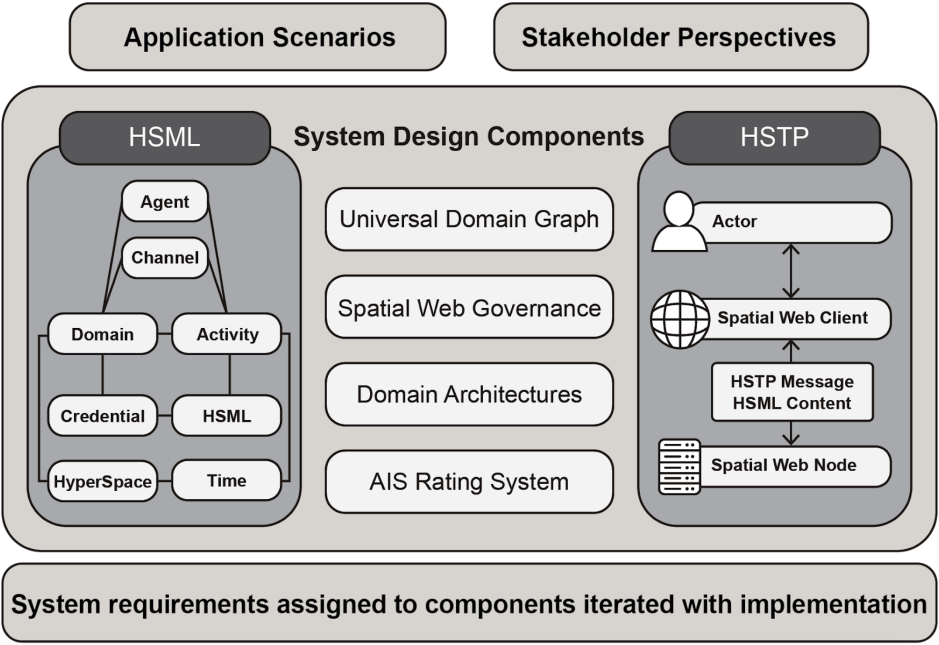
There’s HSML (Hyperspace Modeling Language), the HTML equivalent. It describes what an entity is, where it is, what state it’s in, and what it can do. A thermostat, a drone, a water pump - each publishes an HSML description of itself.
Then there’s HSTP (Hyperspace Transaction Protocol), the HTTP equivalent. It governs how entities negotiate and transact with each other. An ambulance requests green lights. A drone confirms airspace clearance before takeoff. Devices that have never met can coordinate because they speak the same language.
And there’s the Universal Domain Graph - a distributed map of all entity relationships. Think of it as the DNS of the physical world. Every entity gets a decentralized identifier, so it can be found, verified, and trusted.
The standard was ratified in May 2025 with 92% first-ballot approval. Over 100 organizations contributed. NASA’s Jet Propulsion Laboratory already ran a pilot where rovers used HSML to coordinate a simulated lunar rescue - one rover got stuck in a crater and broadcast its geometry, sensor data, and activity state so nearby rovers could respond.
If the pattern feels familiar, it should. In late 2024, Anthropic released the Model Context Protocol - MCP. It solved the same class of problem for AI: how do models talk to external tools? Before MCP, every integration was custom. Within a year, the ecosystem grew to over 10,000 active servers. OpenAI, Google, and Microsoft adopted it. One protocol replaced thousands of proprietary integrations.
The Spatial Web is doing the same thing - but for the physical world. Where MCP connects AI to software, the Spatial Web connects intelligent devices to each other. Different manufacturers, different countries - one protocol.
Yann LeCun said something at NVIDIA GTC 2025 that stuck with me: “I’m not interested in LLMs anymore - they’re the past. The future is in four more interesting areas: machines that understand the physical world, persistent memory, reasoning, and planning.” He went further: “We’re not even close to matching the understanding of the physical world of any animal, cat or dog.”
If that’s the future - machines that reason about physical reality - then the Spatial Web is the infrastructure that future needs. Proprietary silos don’t scale. Standards do.
The sovereignty problem
You might be thinking: isn’t this just the Internet of Things with a new name?
No. And the difference matters.
IoT connects devices to the cloud. Your thermostat talks to Google’s server. Your fitness tracker talks to Apple’s server. Every device is tethered to a proprietary platform. The data flows up and out. The intelligence lives elsewhere.
The Spatial Web connects devices to each other through a shared language. No middleman. No proprietary cloud. The intelligence is distributed. The coordination is peer-to-peer.
IoT created a world where African farmers’ soil data gets processed in data centers in Northern Virginia. South African developers already cite incompatible firmware and proprietary APIs as top barriers to scaling connected agriculture. The Africa Minigrids Program spans 21 countries, but interoperability remains a core challenge - “multiple disconnected platforms” that can’t talk to each other. And 25 to 30 percent of vaccines are lost in sub-Saharan Africa due to temperature excursions along cold chains where devices from different manufacturers have no way to coordinate.
The physical world is full of intelligent devices that can’t understand each other. Not because they lack capability - because they lack a common language.
That’s not a technical problem. That’s a sovereignty problem. When your devices can only speak through someone else’s cloud, someone else owns the conversation.
What this looks like on the ground
Every time a new global standard emerges, Africa faces the same fork in the road. Adopt what others build, or build something that fits.
M-Pesa is the greatest example of the second path. While the West was still debating mobile payments, Kenya built a system that worked for people who didn’t have bank accounts. It wasn’t a copy of Western banking - it was a fundamentally different approach, designed for local realities. M-Pesa didn’t succeed because it was technically superior. It succeeded because it solved a problem that mattered to real people, using the infrastructure they actually had.
The Spatial Web presents the same opportunity. Not for autonomous vehicles on highways - we’re not there yet, and that’s fine. But for problems that Africa faces right now.
A soil sensor in rural Senegal publishes its moisture data in HSML. An irrigation pump in the next field understands that data without a proprietary app, without a cloud subscription, without the same manufacturer. A weather station upstream adds context. The system coordinates autonomously. No middleman. No vendor lock-in.
Every refrigeration unit along a vaccine route from Dakar to a rural clinic publishes its temperature state. If one fails, the system reroutes automatically - not through a central server in Dublin or Virginia, but through direct device-to-device negotiation. The protocol handles the trust. The protocol handles the handoff.
Solar panels, batteries, and demand points across East African mini-grids all speaking the same language. When one village generates excess power, neighboring grids negotiate distribution in real time. No utility company mediating. No proprietary platform extracting fees.
Traffic lights, water pumps, waste collection vehicles, air quality sensors - all publishing their state, all negotiable. A city doesn’t need a $50 million smart city platform from Cisco. It needs devices that can talk to each other.
The common thread? Local problems, solved locally, through a global standard.
The cost of building on someone else’s architecture
We can see what happens when infrastructure gets designed without you.
Out of 9,170 published Internet standards (RFCs), Africa authored 15. That’s 0.26%. Developing countries hold less than one-third of technical committee seats at ISO, despite their economic stakes. The World Bank’s 2025 Development Report puts it plainly: “A poor choice of standards, their weak implementation, or exclusion from participation in the process of setting standards can negatively impact developing economies.”
The consequences aren’t abstract. Web traffic between Nairobi and Lagos still routes through London or Marseille - because the internet’s architecture was designed around Western hubs. Africa has 223 data centers across 38 countries, so most African data gets processed on foreign servers. Local providers can be 15 to 30 percent more cost-effective for certain workloads when data stays in-country - meaning we’ve been overpaying by default. Non-tariff measures, including standards-based requirements, now affect 90% of global trade, up from 15% in the late 1990s. Countries that don’t write the rules still have to comply with them.
This isn’t about blame. Africa’s absence from early internet standards bodies was a symptom of the same infrastructure gaps, not solely the cause. The two reinforced each other. But the pattern is clear: when you inherit architecture designed for someone else’s constraints, you pay a premium - in cost, in latency, in sovereignty - for decades.
The Spatial Web standard was ratified in May 2025. The domain-specific architectures - for transportation, energy, agriculture - are still being developed. The IEEE has expanded electronic participation to lower barriers for developing countries. The ITU’s Africa Regional Initiatives already emphasize interoperability standards to address digital transformation challenges.
I don’t know if IEEE 2874 specifically will be the one that sticks. Standards have failed before. Ecosystems have stalled before. But the direction is clear: the physical world needs a shared protocol, and whoever engages early gets to design for their own reality.
This time, the window is still open.
African engineers in the working groups defining domain architectures. African universities teaching this as practical infrastructure design - the same way Kenyan developers built M-Pesa on USSD. African governments recognizing that the next wave of infrastructure isn’t just roads and bridges - it’s protocols and standards. African entrepreneurs building foundational technology, not just applications on top of someone else’s platform.
From consumers to architects
We’ve spent decades importing infrastructure that wasn’t designed for our realities. Standards are infrastructure too - and for once, this one is still being written.
Whether it’s IEEE 2874 or something that follows, the physical world needs a shared language. The devices around us are getting intelligent. The question is who starts building on that language first.
Maybe it won’t be this standard. Maybe it’ll be the next one. But the direction is clear, and the preparation starts now.
The earlier we embrace it, the less we’ll have to catch up later.